

Why the democratic reform of the law enforcement and judicial systems of the post-Soviet states slows down?
Attorney at Law Roman Khmara, a graduate with honors from the Yaroslav Mudryi National Law Academy of Ukraine, a member of the Union of Lawyers of Ukraine and the National Association of Lawyers of Ukraine since 2008. He has been repeatedly awarded national and international awards, an active participant in many national and international conferences, in particular, conferences at the US Supreme Court and the European Court of Human Rights, is a finalist of the international program “Open World” for the leaders of his state, which is the only exchange program within legislative branch of the US government and receives annual funding from the US Congress. Lawyer Roman Khmara has been actively participating in various advocacy events for many years, conducts active public, scientific and media activities, conducts internships for future lawyers, constantly improves his own unique democratic legal research work on reforming and improving the law enforcement and judicial systems of various countries. In order to continue activities in the field of democratic legal research, ensure the protection of human rights and help in the preparation of documents for vulnerable segments of the population, he was enrolled in the School of American Law and founded the company “United Smart Assistance”, which has already begun to actively work in the democratic direction.
How it all began…
I studied at one of the best law schools in Europe at the time. After graduating with honors, I began my adult legal career with extremely high ideals. The contrast between the life and professional principles of the old and new life became colossal for me. My first job after graduating from law school was the police. I was assigned to the district department as an investigator. A year later, for my successful work, I was transferred to the regional investigative department, where I soon became a senior investigator.
But while working in the police, I began to feel a certain latent artificiality that permeates the entire law enforcement and judicial system. There was a feeling that absolutely everyone was suffering from this, but they resigned themselves, because they believe that this is how it should be, otherwise it cannot be. I wrote a letter to the Minister of Internal Affairs, where I expressed my thoughts. A month later, the very embarrassed head of the district police department, who received the minister’s answer to my name, summoned me to his office. In the letter, the minister unexpectedly confirmed the relevance of the described problems and the need to find ways to solve them.
Since then, I have begun to investigate this question in more detail. During several years of work in the police, I discovered a complex of problems, one of which, in my opinion, is key and extremely important, as it has global significance and affects the development of democracy in the world.
Building a legal democratic state is impossible without creating a legal democratic law enforcement and judicial system. What to do when huge funds of the USA and European democratic partners are spent on reforming these systems in Ukraine and other post-communist countries, but there is no result? For global democracy, the question is extremely acute: why are democratic reforms in these countries progressing so slowly. For decades of attempts to build democracy, unfortunately, few people have understood why the reforms do not give the desired result.
For more than ten years, I have been engaged in legal research on the problems of promoting democratic reforms in post-Soviet countries, in particular in Ukraine. My research not only provides substantial answers to the above-mentioned problematic questions, but also reveals the hidden diseases of the law enforcement and judicial systems — diseases that hinder democratic development, and offers practical recommendations on how to quickly and effectively move such problematic reforms from place. My research work is a project aimed at a fundamental and qualitative change in the law enforcement and judicial systems of post-communist states.
First of all, I identified the main hidden disease of democratic reforms in this area, specific to these countries. I consider the reform of these systems from a radically different perspective — primarily through the prism of reforming the system of evaluating the activities of law enforcement and judicial bodies. In order to develop a unique and effective system of adaptation of the post-Soviet countries to the democratic legal field and the practical (not declarative on paper) integration of this system into life, in-depth knowledge is needed in the field of the subtle specifics of the functioning of the law enforcement and judicial systems of the post-Soviet countries and countries of stable democracies. My system is a unique compilation of qualitative and quantitative indicators that take into account the subtle historical, social and legal features of post-Soviet states. An extremely painful problem for these states is the traditional Soviet quantitative criteria for evaluating the effectiveness of law enforcement agencies. Among the quantitative indicators in the new evaluation system that I am developing, only those that cannot be manipulated will remain. The system of quality indicators will largely be represented by the American experience in this field. Currently, most of the comprehensive assessment system under development is almost ready, it needs to be detailed and refined based on practical American experience.
According to my research, it is impossible to build democracy in the post-Soviet countries without a radical change in the Soviet system of evaluating the activities of law enforcement and judicial bodies, which, unfortunately, continues to dominate until now, the old evaluation system, carefully hidden in the corners of by-laws and departmental regulations, is a cancerous tumor in democratic efforts and prospects of post-Soviet countries. This system hinders all democratic processes and efforts of democratic partners. If this factor is not taken into account when carrying out democratic reforms, then the form of state institutions will change permanently, but the content, unfortunately, will not. The completion of the study and the new evaluation model I am developing will be truly revolutionary for the democratic breakthrough of the post-Soviet states.
Members of the Ukrainian parliament, representatives of the executive branch of government, and international partners who are interested in my legal democratic developments are interested in this issue. Also, the US Congress was interested in these legal studies on reforming the judicial and law enforcement systems, because in 2012 I became a finalist of the international program “Open World”.
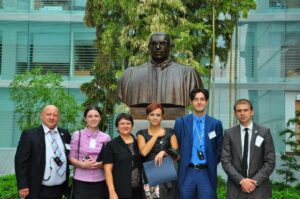
US Supreme Court. Conference with judges. Delegation of finalists of the “Open World” program on the topic “Rule of Law”. Washington, DC, 2012

In the Supreme Court of North Carolina, USA

Meeting with Brad Miller, congressman, US representative from North Carolina (2003-2013), member of the Democratic Party, American lawyer.
The importance of my legal democratic research project is also confirmed by the interest in it of the democratic presidents of Ukraine.

Meeting with the President of Ukraine (2005-2010) Viktor Yushchenko
Until now, few people have paid due attention to this extremely important factor, no one has yet developed a democratic evaluation system perfectly adapted to the legal, historical, social and other features of the post-Soviet states. It has not yet been possible to carry out a full-fledged development of a new evaluation system, since this can only be done in the academic and professional environment of stable democracies with long successful experience in this field, where there is access to relevant professional libraries and the possibility of joint direct research work with legal colleagues, scientists, human rights defenders, extras, law enforcement officers, judges. Currently, I am in the USA, where in order to qualitatively continue my democratic studies, I was enrolled in the School of American Law and founded the company “United Smart Assistance”, which has already begun to actively work in the democratic direction. After the completion of the last stage of this research in the USA, the mechanism of implementing the model of the new system in the post-Soviet countries will be quite simple. For this, it is not even necessary to adopt a new relevant law in these states, it is enough to introduce a new evaluation system by a by-law. As for Ukraine, the corresponding law and resolution have already been adopted here. However, for some reason, both law enforcement officers and citizens continue to live and work according to the old Soviet rules, in a toxic legal and professional climate. Why? Because there is no evaluation model that will replace the old one.
Perhaps for an ordinary person, the term “legal statistics” sounds too dry and uninteresting, but believe me, this phenomenon in post-Soviet countries has a negative effect on almost every person on a daily basis, and legal statistics, in my opinion, are one of the biggest problems of the modern criminal legal situation in these states. Let me explain why. The fact is that these states inherited from the USSR an imperfect system of indicators, where the main criterion for evaluating the success of law enforcement agencies is the “percentage of crimes solved”, in other words, the more crimes are recognized as solved, the more criminal cases are sent to court, the better they allegedly worked law enforcement agencies. This Soviet evaluation system is an extremely negative phenomenon for human rights and freedoms, which is characteristic of all countries that were formerly part of the USSR. The situation has remained stable since the middle of the last century, when the system of Soviet-style criminal justice bodies and the corresponding established practice of its work were finally formed. The acquittal for judges and prosecutors was not only an undesirable result, but also an obviously negative one that significantly undermines the authority of the judiciary and law enforcement agencies. Since then, despite all the unsuccessful democratic attempts of the USA and European partners, the system of incentives and indicators in the post-Soviet states stubbornly does not change in principled approaches, so the acquittal is more a failure of the system than just a result.
Courts, in the vast majority of cases, work in unison with law enforcement agencies (if they can be called that), otherwise, for example, in Ukraine we would not have such a sad indicator of acquittals among the total number of verdicts. If we talk about the final percentage of acquitted, then, for example, in Ukraine (individuals for whom the verdicts have entered into force), it is 0.3–0.4%, in Moldova, Kazakhstan — 0.5–0.6%, in Belarus, Russia — 0.1.
Unfortunately, in the post-Soviet countries, abstract quantitative indicators prevail over qualitative ones, which leads to massive manipulation of statistical cards. Every month we have a huge number of fictitious crimes, the effectiveness of which we know only from the indicators provided by the police themselves. Therefore, our knowledge of crime is completely distorted by the presence of such a system. The question of guilt is actually decided already at the stage of announcing the suspicion to the person. Therefore, if the defense allowed the prosecution to reach this procedural stage, in the vast majority of cases, a guilty verdict can be expected in court.
I am sure that everyone has heard about cases in Ukraine and other post-Soviet states where people are serving sentences for crimes they did not commit, where organized criminal groups are artificially created at the level of statistical indicators, and real powerful criminal organizations continue their activities, where in the case evidence is falsified, torture takes place in law enforcement officers’ offices, and if there is a lack of a “statistical indicator” for a certain category of crime, such a crime is initiated. The victims, in turn, are refused to report to the police, crimes are registered that do not correspond to their severity, illegal detentions are carried out, procedural guarantees are manipulated in relation to the suspect, etc. The victims of the system are ordinary people who rarely dare to speak about it publicly.
All this is the result of the race of law enforcement agencies for statistical whimsical indicators, and therefore in Ukraine and other post-Soviet states, it is not the criminal legal situation that forms the legal statistics, but the opposite.
All this could be ignored if it were not so sad and if it did not concern every ordinary person, because each of us can be caught on the street, beat out any testimony, falsify evidence, or even be imprisoned for a long time. And, unfortunately, international conventions, declarations, new procedural codes, re-certifications, lustrations of law enforcement and judicial officials, creation of new law enforcement and judicial structures, European renovations in their premises will not have a significant impact on this. Moreover, the representatives of law enforcement and judicial bodies themselves literally hate the established Soviet system of evaluating their activities, but they are unable to do anything about it. Because they don’t know how.
If we talk about the reform of the militia in Ukraine, then frankly speaking, it must be recognized as a defeat. The police leadership informs the public about “results”, ongoing projects to create new units, reorganize old ones, subordination of some units to others, purchase of new equipment, repair of premises, re-certification of employees, etc. But no one is talking about the real, long-awaited results. Did the so-called reforms really increase the effectiveness of crime investigations, the level of public trust, and the level of citizen safety? The most famous stages of the reform: the renaming of the militia to the police, the separation of the National Police from the Ministry of Internal Affairs, the creation of the patrol police, re-certification, lustration of police officers, massive repairs in departments, administrations — all this at the expense of democratic partners. Frankly speaking, the change in the name of the law enforcement agency did not change much, except for the name itself, the separation of the National Police from the Ministry of Internal Affairs took place more on paper than in practice. Re-certification was also more formal than real, because in the end only 6-8% of former police officers were dismissed. Repairs in the premises did not affect the quality of crime investigations and the attitude of law enforcement officers towards citizens.
The police and the prosecutor’s office, evaluating their own work, continue to use departmental statistics, which allegedly indicate a constant decrease in the number of registered crimes and an increase in the number of solved ones. All this is called quantitative and statistical data, which in practice, for the most part, are distorted and say little about both professionals and ordinary citizens, and what is most surprising – to law enforcement officers themselves.
Have you ever wondered why drug addiction continues to thrive? Why are many of our cities powerful centers of production of narcotic and psychotropic substances?
Official statistics of the General Prosecutor’s Office of Ukraine show impressive figures that illustrate the state of the fight against illegal drug trafficking. As a rule, about 80% of drug crimes are registered, not related to drug sales, and only about 10% are sales. From the given statistical data, it can be concluded that the attention of law enforcement officers is focused precisely on the users of narcotic and psychotropic substances, and not on those who distribute them – the cause of the spread of drug addiction.
It is probably not a secret for many that the law enforcement officers who are responsible for this line of work know well not only all persons who keep drug dens, all persons who distribute narcotic substances and precursors, but also all drug addicts, and if desired, such a problem as drug addiction in every district, neighborhood of the city, in most cases, could be overcome in a relatively short period of time. However, the point is that in addition to the corruption component of this problem, there is also a statistical one. It is much easier and more profitable for such a policeman to “hand over to the law” the required minimum statistical number of drug addicts for one regular reporting period, thus closing his “statistical indicator”, than to liquidate the entire drug den.
Most law enforcement officers know that in the post-Soviet states, in particular, in Ukraine, there is also a practice of artificially regulating the closure of criminal proceedings. This means that the employees of the prosecutor’s office themselves create the “statistics” they need, which have nothing to do with reality. Certain numbers of closed proceedings are necessary for the respective heads of territorial divisions of law enforcement agencies in order to have a high percentage of solving crimes. This percentage can be adjusted, since its increase is affected by the increase in the number of closed proceedings. Therefore, heads of pre-trial investigation bodies are forced to close a certain number of criminal proceedings in order to have “correct indicators”.
Stalin’s “legal statistics” over many decades have deeply rooted in all spheres of life of the post-Soviet states, which, despite the democratic wrapper, continue to function according to Soviet rules. Frankly speaking, as we see in practice, the democratic reforms of the law enforcement and judicial systems failed due to an ineffective and unprofessional approach. Due to ignorance of the real hidden diseases of these systems. And, unless drastic changes are made in the field of legal statistics, the police will continue to work for whimsical indicators, and not for the citizens, at the expense of which they actually work, and the courts will continue to fear acquittals like fire.
What to do next?
For example, in the USA, quantitative and statistical evaluation was abandoned in the twenties of the last century, recognizing its ineffectiveness. The post-Soviet states should have long ago abandoned the evaluation of the work of investigative and operational units based exclusively on quantitative and statistical indicators. However, if, for example, the American evaluation system is simply copied, it will not work in these countries due to the presence of a complex of historical, legal, statistical, social, cultural and other circumstances. A new comprehensive assessment system is needed, based on quantitative and qualitative assessment criteria, with careful consideration of all the specificities of these countries.
As for qualitative indicators, the experience of British and American “criminological surveys” is a good enough alternative to the existing statistical system. It is about describing the state of crime precisely by sociological methods. To do this, people are asked whether they have been victims of crime during a certain period of time and whether they have reported it to the police, and if not, why. Were they denied an investigation, were they satisfied with its results, if the matter went to the police, etc. The National Crime Victimization Survey (NCVS), conducted by the US Census Bureau under the Department of Commerce, is a national survey of approximately 49,000 to 150,000 households (approximately 240,000 individuals age 12 and older) twice a year. The survey focuses on collecting information on the following crimes: assault, burglary, carjacking, rape and robbery. The results of the study are used to construct the crime index. It was used against the Uniform Crime Reports and the National Incident Reporting System to reveal the “dark figure” of crime. The NCVS survey is comparable to the British Crime Survey in the UK. The NCVS began in 1972 and was developed based on work done by the National Opinion Research Center and the President’s Commission on Law Enforcement and the Administration of Justice. A key finding of the survey was the realization that many crimes go unreported to the police.
In most post-Soviet states, unfortunately, they continue to operate with distorted criminal statistics for decades, and the police itself has been spinning in a closed circle for almost a century and does not know what it is fighting against.
Thanks to our active public activities in Ukraine, speeches in the press, joint conferences with people’s deputies, representatives of the executive power, personal contacts with representatives of the authorities, efforts to protect democratic values and human rights, we managed to achieve consolidation at the legislative level of the requirement that the main criterion assessment of the effectiveness of the work of police bodies and units is the level of trust of citizens in the police (Law of Ukraine “On the National Police”, Article 11, Part 3). However, this is only part of the way to go. There is an urgent need to complete the development of the evaluation system. We have good communication with many truly democratic representatives of the authorities, there is an understanding in which direction to move, but for the implementation of the project it is necessary to bring to a logical conclusion the final stage of research in the United States of America, since the final practical recommendations can be made only on the basis of the practical experience of law enforcement bodies, courts of various instances and academic American experience. I want to emphasize once again that the success of this project will concern not only Ukraine and the post-Soviet states, but will also have global democratic consequences.
Separately, I want to touch on the issue of democratic partners’ expenses for reforming the law enforcement and judicial system of Ukraine. In the US alone, for example, between 1991 and 2014, USAID spent heavily on democracy-building efforts, including judicial reform, as part of a broader $5 billion investment. This figure includes various programs aimed at promoting democracy.
In 2023 alone, the United States spent $203 million to support democracy, ensure respect for human rights in Ukraine, fight corruption, ensure accountability in the field of human rights, continue judicial reform, and develop civil society.
(https://www.state.gov/supporting-justice-and-accountability-in-ukraine/)
In addition, the US has supported judicial and law enforcement reforms in other former Soviet states through various initiatives. Although exact country-by-country figures are more difficult to determine due to the fragmented nature of funding sources and the wide range of programs involved, the total spending is in the billions of dollars, reflecting a long-term commitment to the development of democratic institutions and the rule of law in the region. And now imagine if these states use such funds constructively, direct them to overcome the main problems, and not secondary ones.
Agree, because no matter how strange it sounds in today’s reality, everyone would be happy to come to the district police station with their own problem, and there the policeman will meet you with a sincere smile, trying to help you solve this problem with all possible actions of his own, because he knows that you are the main indicator of the success of his work. Moreover, communicating every day with representatives of the law enforcement and judicial system, I know for sure that they themselves dream of working in a radically different format – a format of cooperation, transparency, simplicity and mutual assistance, where the race for whimsical quantitative indicators every minute does not put pressure on them and their families .
I am happy to invite my colleagues, specialists, who care about this extremely important issue, to join the joint implementation of the project for the sake of a common result.